-
Email sales@cherryplastics.com
-
Call +92 334 3195599
Email sales@cherryplastics.com
Call +92 334 3195599
Not every plastic crate does the same job. A crate built for bakery ventilation will fail at liquid containment. A deep storage crate meant for bulk parts is wrong for single-layer produce inspection. In Pakistan, where industries from food processing to pharmaceuticals rely on reusable plastic crates across their supply chains, understanding the differences between crate types prevents the common mistake of buying on price alone and dealing with the consequences later. Choosing the right type of plastic crate directly affects product safety, handling speed and long-term cost.
This guide covers every major type, what each is built for and which industries they serve best.
Walk into any warehouse in Pakistan's industrial zones and you will find mismatched crates doing jobs they were never designed for. Closed-wall crates holding fresh produce that needs airflow. Shallow trays stacked three high with weight they cannot support. Perforated crates leaking liquids across transport vehicles.
These mismatches cause measurable product loss, slow down operations and create hygiene risks that fail audit inspections. The price difference between a PKR 1,200 crate and a PKR 1,800 crate means nothing when the wrong type ruins PKR 50,000 worth of goods in one shipment.
Each crate type exists because specific industries needed a specific combination of airflow, containment, depth, weight capacity and stacking behavior.
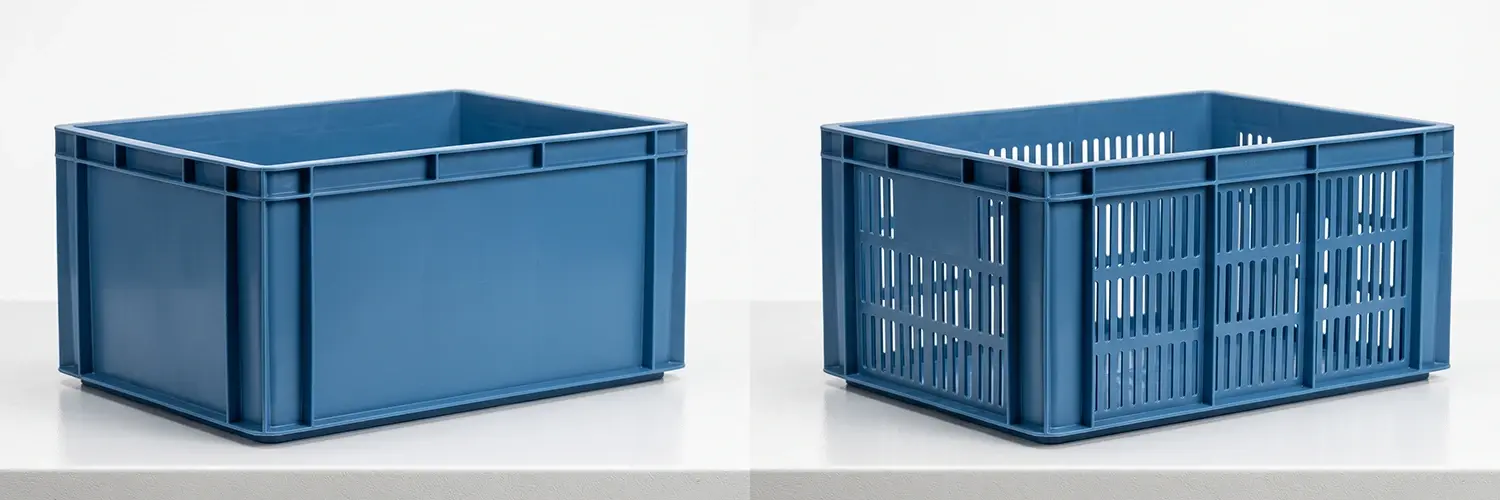
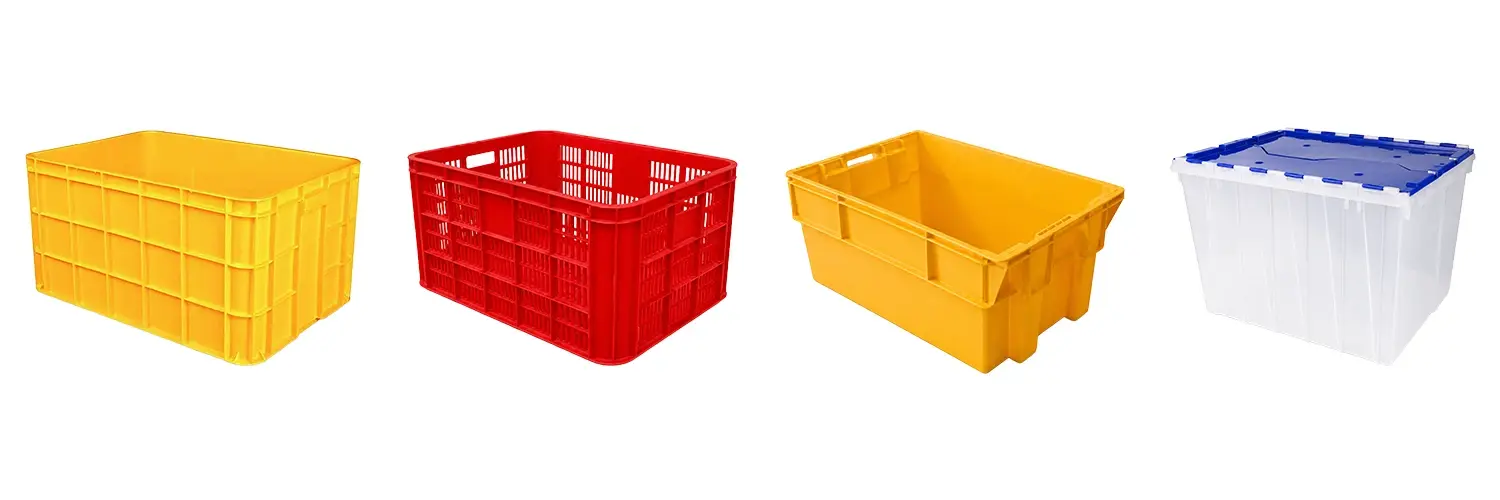
Plain crates have solid, non-perforated walls and bases. They are the default choice when the priority is protecting contents from dust, moisture, insects and contamination rather than providing airflow.
The closed-wall construction creates a sealed environment that prevents liquid leakage outward and contamination inward. They come in multiple sizes:
Food processing and dairy operations rely on them for liquids and packaged products that must stay sealed. Pharmaceutical warehouses use them for contamination-free storage of raw materials and finished goods. Industrial assembly lines keep nuts, bolts and hardware organized in them. Retail distribution centers move packaged consumer goods through supply chains where dust and moisture exposure would affect product quality.

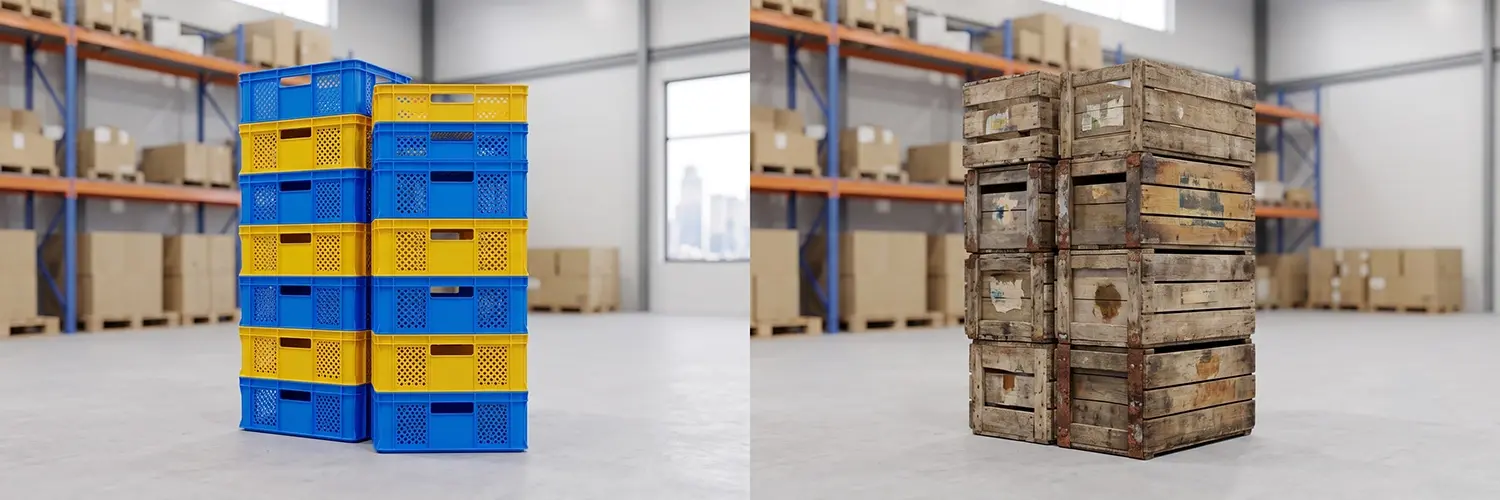
Perforated crates have slots, holes or mesh patterns in their walls and sometimes their base. This promotes continuous airflow around stored products.
Fresh fruits and vegetables continue to respire after harvest, releasing heat and moisture. Without airflow, this trapped warmth accelerates spoilage and promotes bacterial growth. Perforated crates solve this by letting air circulate freely around the product.
Fruit and vegetable supply chains, bakeries, poultry handlers and post-harvest agricultural operations all depend on these crates daily.
If your product needs protection from dust or moisture, use plain. If it generates heat or moisture and needs airflow, use perforated. Because both versions share identical outer dimensions within each size family, they stack evenly together. Warehouses can mix plain and perforated crates in the same racking without compatibility issues.
These crates solve one of the biggest costs in reusable crate systems, transporting empties back to the origin.
When loaded, they lock together through an interlocking rim mechanism. When empty, they rotate 180 degrees and nest inside each other, reducing empty crate volume by up to 70%. This dual behavior means loaded crates stack safely and empties compress dramatically for return trips.
Stack and nest crates are widely used in retail and FMCG distribution, bakery delivery networks, e-commerce, last-mile logistics and export packing. Full crates can be delivered efficiently, while empty crates nest together on return trips, reducing space, transport costs and handling effort.
Low-height crates, typically 90mm deep, are designed for products that benefit from single-layer arrangement rather than deep stacking.
Plain low-height options like the P-6 (580x390x90mm) work for meat, dairy and seafood where leakage protection matters. Perforated versions like the J-6 are purpose-built for bread, cakes, pastries and samosas, releasing heat and moisture from freshly baked items.
Unlike standard crates that need a separate lid, the Attached Lid Plastic Crate (P-17) integrates a hinged cover directly into the body. It closes securely when loaded and nests flat when empty.
Separate lids get lost, mixed up between sizes, or left behind during fast-paced loading. An integrated lid eliminates all of that. It also provides tamper evidence, since an open lid is immediately visible, which matters for pharmaceutical and high-value shipments. Document archival, retail store-to-store transfers and automotive parts distribution all benefit from this design.
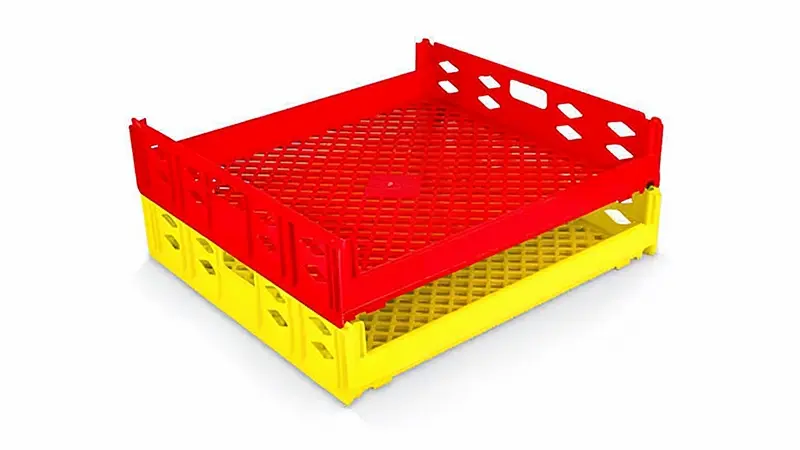
While general perforated crates work for many bakery applications, the Bread Plastic Crate (J-24) is engineered specifically for hygienic bread distribution. It combines optimized ventilation slot patterns with a stackable and nestable design built around the physical characteristics of bread loaves.
Commercial bakeries, supermarket chains and hotel supply operations across Pakistan use these for daily distribution cycles where thousands of loaves move from production to retail.
For heavy or bulky products, standard crates fall short. The Large Heavy-Duty Plastic Crate (P-13) at 600x500x400mm is reinforced for industrial loads. The Large Perforated Plastic Tray (J-19) at 730x300x80mm provides a wide surface area for single-layer arrangement during cooling and inspection.
These serve manufacturing and assembly lines handling metal parts, construction hardware, and bulk agricultural produce moving from farms to processing facilities.
The Export Plastic Crate (EP-11) shares its footprint with the standard J-11 at 505x355x275mm but meets international shipping requirements. When destination markets have specific material standards or crates must withstand extended transit times and rough handling at foreign ports, export-grade variants become necessary.
Not every storage need requires a full crate. The Plastic Storage Bin (PB-1) at 216x127x89mm is an open-front bin for quick identification and picking of small parts, tools and fasteners. Factory assembly lines, workshops and warehouse bin-rack systems all use them for organized, grab-and-go access.
The Plastic Crate Lid (LD-1) fits any crate with a 580x390mm base, including the P-1, J-1, P-6 and J-6. Adding a lid transforms an open crate into a fully enclosed unit for pharmaceutical storage, hygienic food handling and secure transport. Lidded crates still stack normally.
Selecting the right crate starts with four questions:
All plastic crates from Cherry Plastics are made from food-safe, non-porous materials that support thorough cleaning.
The right plastic crate is not the cheapest one available. It is the one engineered for your specific product, handling environment and industry requirements. Plain crates protect against contamination. Perforated crates prevent spoilage through ventilation. Stack and nest crates cut logistics costs. Low-height crates speed up production-line handling. And specialized variants like bread crates, attached lid crates and export-grade models exist because no single design fits every application.
Understanding these differences and matching each part of your operation to the right crate type is what separates businesses that treat crates as a cost center from those that turn them into a competitive advantage.
Explore the full range of plastic crates and material handling solutions at Cherry Plastics to find the right fit for your operation.
1. What are the main types of plastic crates?
Plain (closed-wall), perforated (ventilated), stack and nest, low-height, attached lid, bread crates, heavy-duty and export-grade variants.
2. What is the difference between plain and perforated plastic crates?
Plain crates have solid walls for contamination protection, while perforated crates have ventilation slots that allow airflow around fresh produce and bakery goods.
3. What are stack and nest crates used for?
They lock together when loaded for secure stacking, then rotate and nest when empty to reduce return-transport volume by up to 70%.
4. Which plastic crate is best for fruits and vegetables?
Perforated crates like the J-1 or J-7, because their ventilated walls let heat and moisture escape, reducing spoilage during storage and transport.
5. Can different types of plastic crates stack together?
Yes, plain and perforated versions within each size family share identical outer dimensions and stack interchangeably.
Copyright 2026 © All Rights Reserved
Designed & Developed by : Digital Hyperlinks (PVT) LTD.