-
Email sales@cherryplastics.com
-
Call +92 334 3195599
Email sales@cherryplastics.com
Call +92 334 3195599
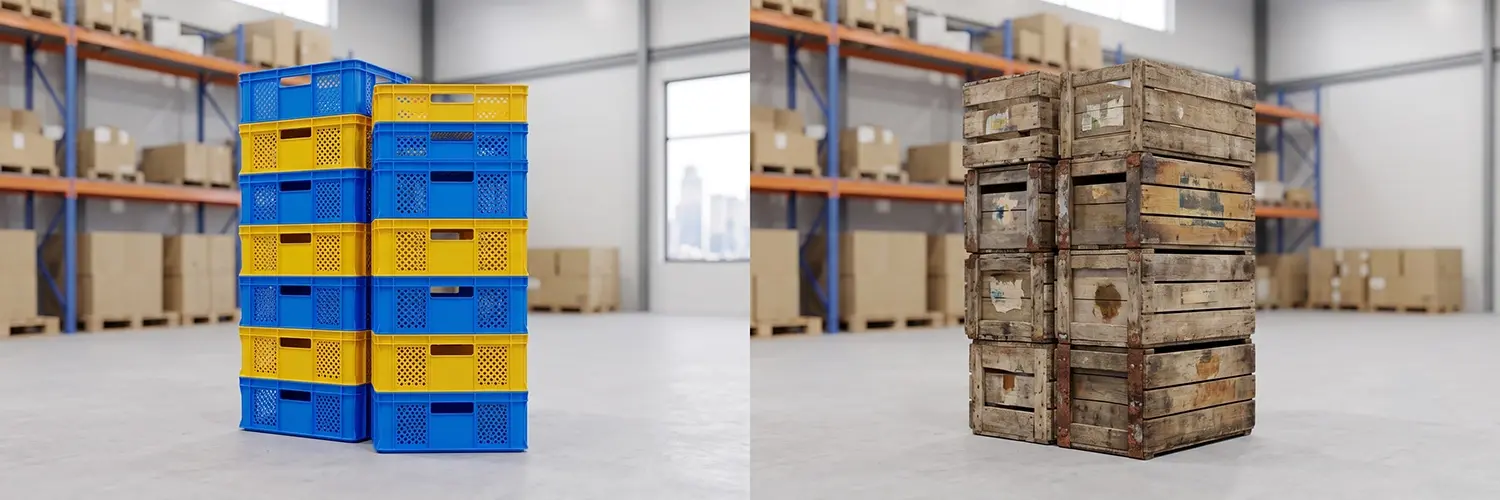
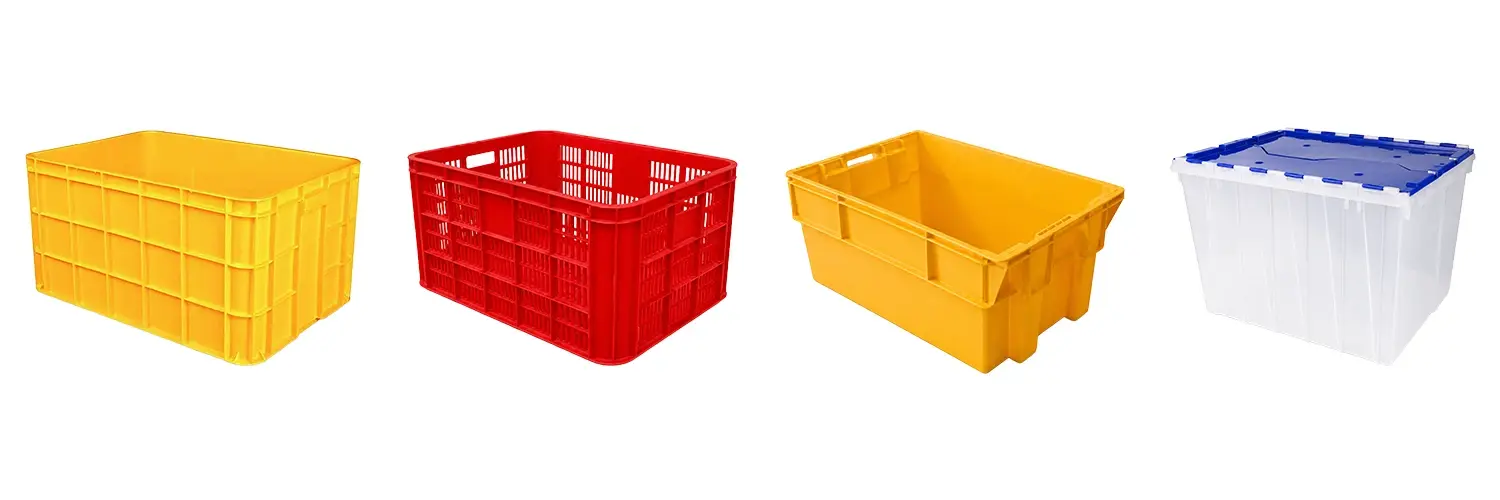
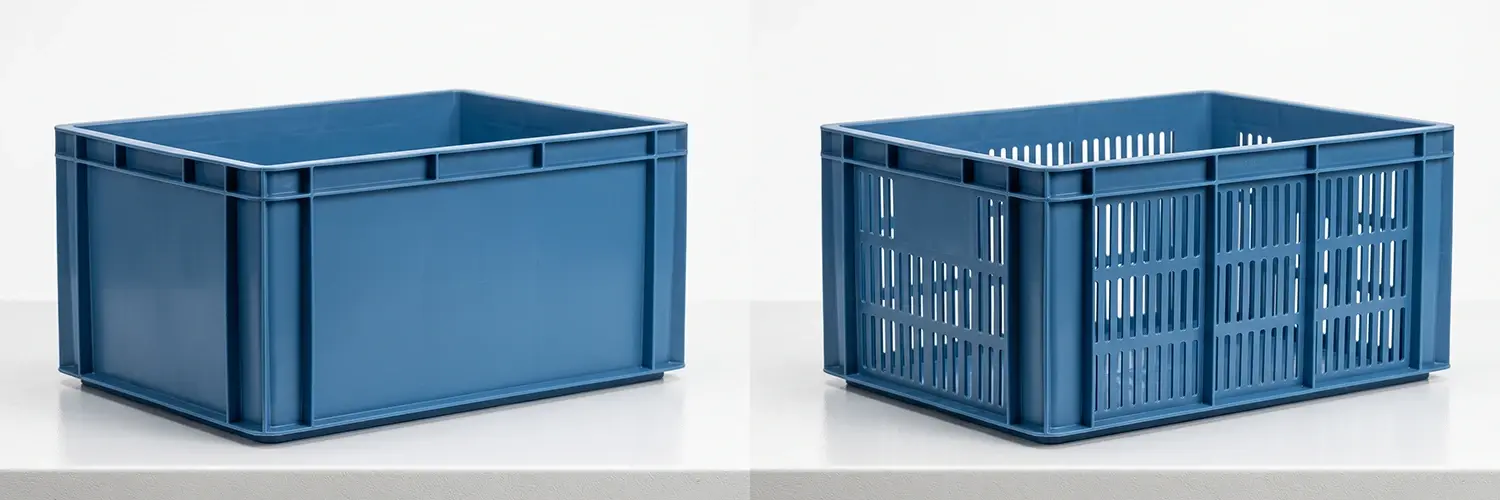
When comparing plain vs perforated plastic crates, the difference comes down to the walls. Plain crates have solid walls that help contain products and reduce exposure to dust, splashes and debris, while perforated ones have slots that let air circulate around the contents.
Plain crates are also called closed-wall crates or solid-wall crates. They have solid sides and usually a solid base, which help contain products and protect them from outside debris.
Perforated crates are often sold as ventilated crates or open-wall crates. They have slots or holes in their walls and sometimes their base to allow airflow and drainage.
Both types can be made from HDPE and are stackable. However, load capacity and compatibility depend on the specific model. The wall design also affects airflow, drainage, cleaning and how well the crate holds smaller items.
Plain crates are the right choice when the priority is containment and protection. The solid walls create a barrier between the product and the warehouse environment. Use plain crates when:
Cherry Plastics plain crate models range from 10L (P-4) for small parts to 85L (P-12) for bulk industrial storage. The P-1 (70L) and P-7 (40L) are the most commonly used sizes for general closed-wall storage.
Perforated crates are the right choice when the product gives off heat, moisture or gases that need to escape. Without crate airflow, trapped heat speeds up spoilage and trapped moisture causes condensation damage. Perforated crates earn their place in these jobs:
Here is a quick crate comparison on the factors that matter most in daily operations.
| Factor | Plain Crates | Perforated Crates |
|---|---|---|
| Airflow | No ventilation through solid walls | Air circulates through the openings |
| Dust protection | Better protection from side exposure | Dust can enter through openings |
| Liquid containment | Solid base contains minor spills | Perforated base allows drainage |
| Cleaning | Smooth walls are easy to wipe, but water can pool | Dries fast, but slots need brushing |
| Stacking | Stacks with its perforated pair (P-1 with J-1) | Stacks with its plain pair (J-1 with P-1) |
Both types are far easier to keep clean than wooden crates. HDPE is nonporous and does not absorb water, which makes it easier to wash and maintain. A wooden crate, by contrast, holds moisture in its grain. Even so, both types need regular cleaning to stop dirt and bacteria from building up.
The two designs still clean differently. Perforated crates rinse out fast and water runs straight through the slots, so they dry quickly between trips. On the other hand, the slots have more edges where pulp and dirt can lodge, so a pressure rinse or a brush helps. Plain crates have smooth inner walls that wipe clean easily. Tip them on their side after washing, though, or water sits in the base.
For crates that come into direct contact with unpackaged food, confirm with your supplier that the material is food-grade and meets the relevant food safety requirements.
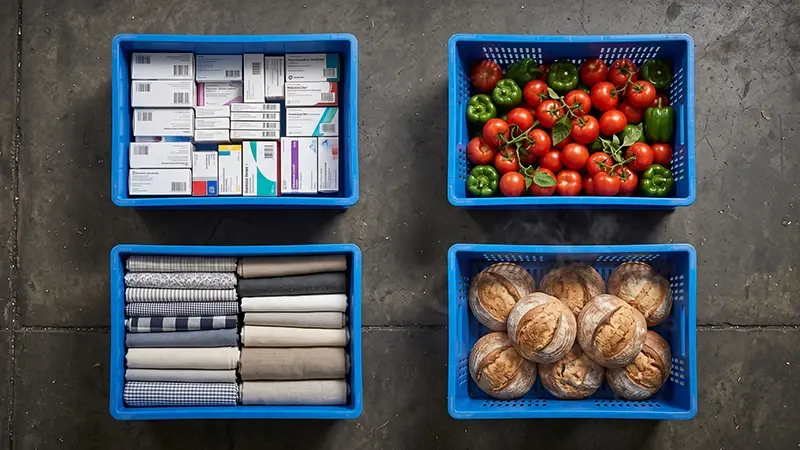
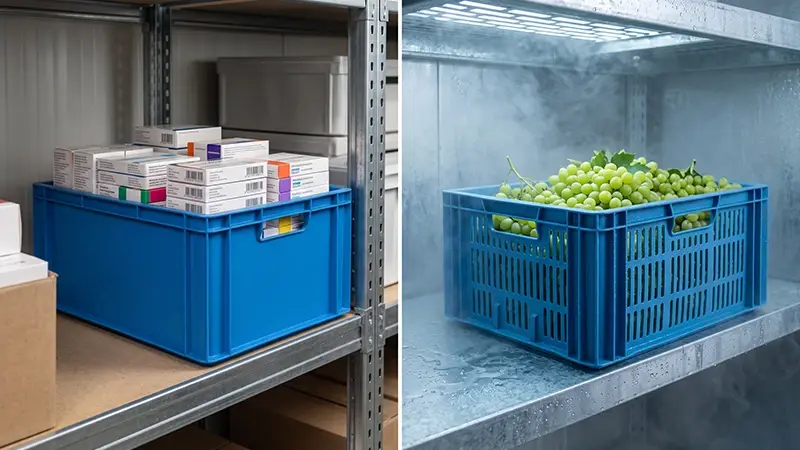
Perforated crates are commonly used for transporting fresh fruits and vegetables because the openings let air circulate and help reduce heat buildup. The J-1 (70L perforated), J-7 (40L perforated) and J-6 (20L low-height perforated) are options for produce handling in mandis and cold storage facilities across Pakistan.
Plain crates are often preferred for packaged medicines, electronic components and other products that need protection from dust and debris. The P-3 (20L plain) and P-6 (20L low-height plain) provide compact storage, although sensitive products may still need extra protective packaging.
Plain crates protect fabric from dust, moisture and color transfer during warehouse storage. Deep plain crates like the P-11 (25L deep) and P-12 (85L extra-deep) fit folded garments and textile rolls without compression.
Businesses handling different products often need both types. For example, a warehouse storing packaged goods alongside fresh produce can use plain crates for containment and perforated crates where airflow is needed.
Standardizing on two or three crate sizes makes stacking and handling easier. Cherry Plastics manufactures matching plain and perforated pairs in the same dimensions. The P-1 and J-1 are both 70L with identical outer measurements, and the P-7 and J-7 are both 40L. As a result, a plain P-1 can sit on a perforated J-1, and your racking, pallets and handling equipment stay the same.
Keep a simple crate comparison sheet at the dock so staff know which type goes where.
Choosing between plastic crate types comes down to one question. Does your product need crate airflow or does it need a sealed space? Ventilated crates, also called open-wall crates, suit produce, bread and fish. Closed-wall crates, sometimes listed as solid-wall crates, protect medicine, parts and dry goods. Run a quick crate comparison for each product line and you will likely order perforated plastic crates alongside plain ones.
Browse Cherry Plastics' complete range of plastic crates to find the right plain and perforated models for your storage and transport requirements.
1. Can plain and perforated crates be stacked together?
Yes, Cherry Plastics plain and perforated models of the same size share identical outer dimensions, so pairs like the P-1 and J-1 stack together.
2. Are perforated crates weaker than plain crates?
A well-made perforated crate uses ribs and reinforced corners to make up for the slots, but always check the rated load for the specific model.
3. Which crate is better for onions and potatoes?
A perforated crate works better because onions and potatoes need steady airflow to stay dry and avoid rot in storage.
4. Can I use perforated crates for packaged food?
Yes, perforated crates are fine for food sealed in its own packaging, though plain crates give better dust protection for unpackaged or loosely wrapped items.
5. Which crate type costs more?
Price depends on size and specifications more than wall type, so choose based on your product's needs rather than price.
6. Which plastic crate is better for cold storage?
Perforated crates are usually preferred when chilled air needs to reach the product, though packaging and stacking layout also affect cooling.
Copyright 2026 © All Rights Reserved
Designed & Developed by : Digital Hyperlinks (PVT) LTD.